What should a university education prepare graduates to do in a world shaped by climate change, shifting industries and complex social challenges? For Tamale Technical University (TaTU), one answer begins with a closer connection between what students learn and the needs of the communities and industries around them.
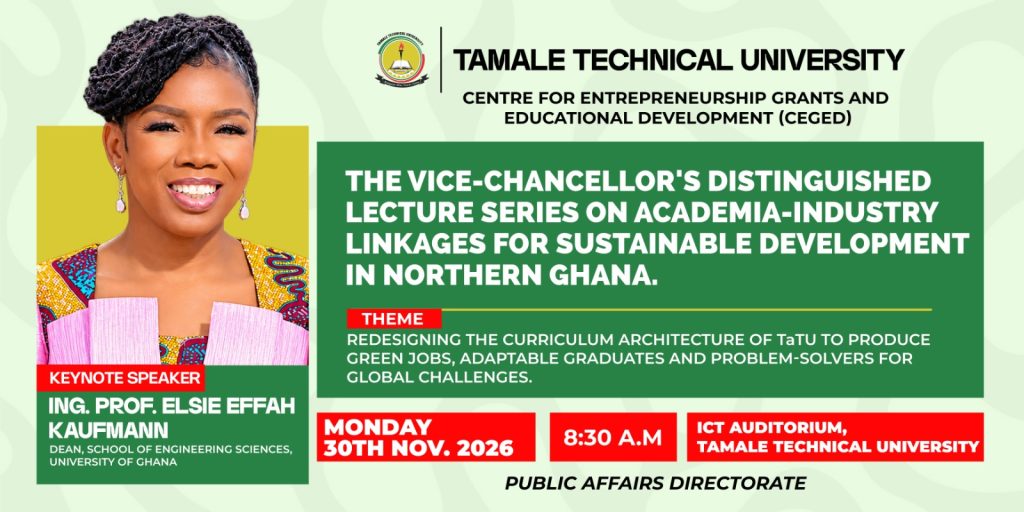
That question is at the heart of the Vice-Chancellor’s Distinguished Lecture Series on Academia–Industry Linkages for Sustainable Development in Northern Ghana. The lecture’s theme “Redesigning the Curriculum Architecture of TaTU to Produce Green Jobs, Adaptable Graduates and Problem-Solvers for Global Challenges” points to an important opportunity: to make education more responsive, practical and future-focused.
Preparing graduates for emerging opportunities
Green jobs are work that contributes to environmental sustainability, whether through cleaner energy, more efficient use of resources, sustainable agriculture, waste management or climate-conscious construction. Preparing students for these opportunities means more than adding a new course or two. It calls for programmes that help learners understand how environmental, economic and community needs connect.
For a technical university, this can mean combining strong subject knowledge with hands-on experience. Students might work on real-world projects, learn from practitioners, and develop skills that can be applied beyond the classroom. The goal is to help graduates enter the workforce ready to contribute and to recognize new opportunities as industries change.
Building adaptability into education
No curriculum can predict every future job. That makes adaptability an essential part of graduate preparation. Communication, teamwork, digital confidence, critical thinking and a willingness to keep learning can help graduates move between roles, respond to new technologies and take on unfamiliar challenges.
An adaptable graduate is not simply someone who can adjust to change. They are also equipped to evaluate information, learn from experience and apply their knowledge in different settings. Embedding these capabilities into technical and professional education can support students throughout their careers.
Connecting learning to real-world challenges
The lecture’s focus on academia–industry linkages also highlights the value of collaboration. Employers and practitioners can help universities understand evolving skills needs, while academic expertise can support innovation and problem-solving in industry and society. When these relationships are purposeful, students gain opportunities to engage with practical challenges before they graduate.
That collaboration matters for Northern Ghana, where solutions should respond to local priorities while drawing on knowledge and ideas from around the world. Students can be encouraged to examine challenges from multiple angles: What is technically possible? What is environmentally responsible? What will work for the people affected? And how can a solution be sustained over time?
A conversation about the future of education
Redesigning a curriculum is an ongoing process. It requires listening to students, educators, employers and communities, then translating what is learned into relevant teaching, meaningful practice and clear outcomes for graduates.
The Vice-Chancellor’s Distinguished Lecture Series offers a platform for that conversation. The keynote speaker is Ing. Prof. Elsie Effah Kaufmann, Dean of the School of Engineering Sciences at the University of Ghana.
The lecture is scheduled for Monday, 30 November 2026, at 8:30 a.m. at the ICT Auditorium, Tamale Technical University.
By bringing education and industry into closer dialogue, TaTU can help shape learning that supports green employment, produces adaptable graduates and equips people to tackle the challenges ahead.